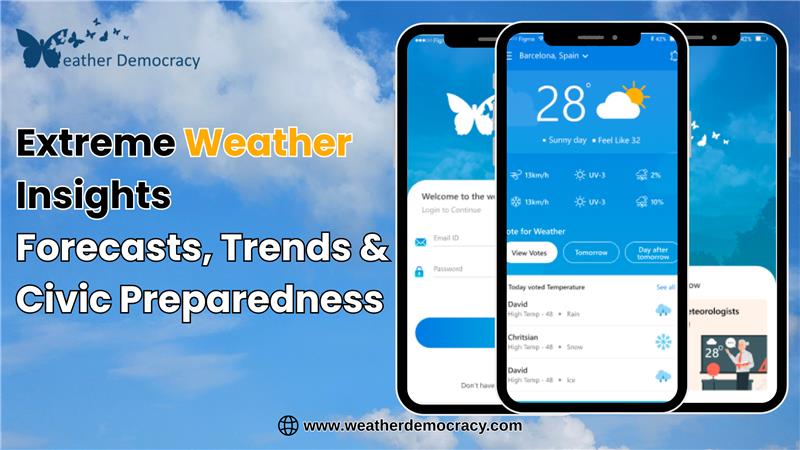
Extreme Weather Insights: Forecasts, Trends & Civic Preparedness
Extreme weather events have been recorded in different parts of the world in recent years and have increased drastically in intensity and frequency. Whether it be scorching heatwaves or record-breaking floods and hurricanes, these events are changing our perception of climatic patterns and their effects in the long term. Extreme weather insights are now more crucial than ever - not only among scientists and meteorologists, but also all communities, policymakers, and citizens who desire to protect lives, property, as well as the environment.
Extreme weather: An understanding
Extreme weather can be defined as extreme or abnormal weather patterns that are not normal, usually have serious impacts, and cause inconvenience. The examples are droughts, wildfires, tornadoes, hurricanes, blizzards, and severe thunderstorms. These are no longer events that are happening in isolated or infrequent scenes, but rather they are a new order of things in most parts of the world.
Climate change is a major factor contributing to the intensification of these phenomena. With an increase in global temperatures, the energy in the atmosphere also increases, which sets favourable conditions in the atmosphere regarding extreme events. Warmer temperature contains more moisture, resulting in high rain and floods, whereas drier areas experience extended droughts and wildfires.
Prediction of Extreme Weather
Proper forecasting is central to the loss of lives and reduction of harm in cases of extreme weather conditions. Meteorologists combine satellite data, radar images, and climate models to forecast the possibilities of the occurrence, timing, and location of such events. Moon leaps in artificial intelligence and machine learning have happened in the last 10 years and have drastically changed the way we read weather data.
In the present case, AI algorithms are capable of processing big data on earlier storms, rainfall, and temperature trends to determine upcoming dangers. Predictive models may be used, as an example, to warn communities of a coastal area of a storm surge several days before it, providing time to evacuate the area or prepare. Likewise, the forecasting of heatwaves will enable the cities to open emergency cooling centres and save vulnerable citizens.
Nevertheless, technology is not the only thing about forecasting, but rather communication. Information has to be converted into understandable and executable messages that individuals can read and believe. This is one of the real differences of such platforms as Weather Democracy: transforming complicated scientific knowledge into the knowledge of the community.
New Fads in Vicious Weather
The trends in weather across the world demonstrate an irrefutable change. As per the latest climate reports, the average temperature of the Earth has risen by approximately 1.2°C since the pre-industrial period. That may not sound very large, but it is sufficient to drastically change the world's weather patterns.
Some of the trends forming the climate conversation today include:
1. Heatwaves Are The New Normal
Extreme heat events are becoming more intense in duration. Cities that were not accustomed to issues associated with heat are recording new records each summer. The phenomenon of urban heat islands, which is induced by the use of concrete and a shortage of green areas, strengthens the impression that preparedness becomes a question of human health.
2. Increasing Sea Level and Coastal Floods
Sea levels are rising at an alarming rate due to the melting glaciers and rising seawater. This immediately affects the coastal cities in the sense that high tides and storm surges are now extending to previously safe areas. Knowledge of extreme weather in coastal prediction can be used to enable locals and the government to build improved flood prevention structures and evacuation procedures.
3. Wildfires and Drought Cycles
High temperatures and lack of rainfall provide ideal conditions for wildfires. The South of Europe, California, and Australia have seen some of the worst fire seasons that have razed down ecosystems and communities in these regions. Food security is also threatened by long-term droughts, where the yield of crops and the production of livestock is curtailed.
4. The storms come and go without any predictability
Storm systems are increasingly difficult to forecast, and their direction and intensity occur suddenly. The formation of tropical cyclones is occurring in strange areas, and the tornadoes are also occurring in new areas beyond the traditional tornado alley. This unpredictability underscores the critical role of early warning systems, which are adaptive and data-driven.
Civic Preparedness: The Preparation of the resilient one
The connection between community safety and weather forecasting is preparedness. Civic preparedness is the capacity of communities to plan, act, and recover from extreme weather. It incorporates collaboration between the government, local governments, emergency agencies, and citizens.
These are some of the major measures to improve civic preparedness:
1. Building Awareness
Preparedness is based on public education. Schools, non-governmental organizations, and media outlets ought to assist citizens in knowing the weather hazards in the region and promote preventive actions. An example is Weather Democracy, which is more friendly to the citizens and provides them with clear and reliable information.
2. Strengthening Infrastructure
The cities must be equipped with infrastructure that can withstand drastic occurrences. A resilient city must have flood defenses, effective drainage systems, fireproof materials, and cooling shelters. Additional vulnerability can be minimized by investing in renewable energy and sustainable architecture.
3. Early Warning Systems
Lives are saved due to efficient early warning systems. Mobility alerts, radio notifications in the locality, and real-time information on social network sites make sure that the warning is delivered in an efficient manner. The incorporation of the local languages and simple graphics can be a way of accessing digitally illiterate populations.
4. Community Engagement
The resilience of the community increases in cases where citizens are included. Disaster management training, first aid, and evacuation training provide the locals with the ability to respond appropriately. It is possible to have neighbourhood networks that share resources and information when there is a crisis.
5. Policy and Planning
Policies that are sensitive to climate need to be imposed by governments. Zoning regulations ought to discourage building in areas that have high risks of floods, and emergency budgets ought to focus on new rapid response mechanisms. These efforts could be sped up through partnerships between the public and the private sectors.
The importance of Technology and Citizen Science
Weather reporters and data collection have become accessible to ordinary citizens due to technology. Drones, weather sensors, and smartphones are able to give real-time information on the speed of wind, temperature, and rainfall. The citizen science platforms persuade individuals to volunteer local data that enhances the accuracy of forecasts.
Weather Democracy is based on this premise - utilizing weather monitoring as a civic activity. We can make weather prediction more democratic and open by integrating professional meteorological instruments and community observations.
Preparing for the Future
With the changing climate patterns, we should be ready to change accordingly. The future resilience is pegged on education, technology, and collaboration. Citizens and governments should collaborate in devising more intelligent systems that are responsive to such dynamic realities.
Finally, extreme weather is not merely an environmental issue; it is also a societal one. We only have to make decisions today that will see us through the storms of tomorrow. Both of us and all the communities are involved and contribute to a safer and more sustainable planet, whether it is with more accurate predictions, more robust infrastructure, or more informed communities.
Conclusion
The insights of Extreme weather give us more than science can give us, the history of our planet in the process of evolution. Once we are taught how to decipher these signals, we are able to unlock the knowledge to be prudent, plan well, and secure our common future. Proactive civic readiness, the use of data to craft policies, and community involvement can change vulnerability to resilience and uncertainty to empowerment.